Tuesday, 20 September 2011

Breakfast in Autumn

I have a lot planned for today so we're going to need a good breakfast, you wander into the kitchen bleary eyed to see the striking colour of fresh orange juice in a wine glass, and a steaming pot of coffee, with two cups, please feel free to help yourself, while I stand by the cooker making the porridge.

My parents have a lot of books at home, so many there's not room for them on our six (I just had to count then) bookshelves so a lot of them are still in boxes, cases, dusty yet appealing. In these books they keep drawing by my siblings and I as children, letters from friends, an old photograph, an obituary of a writer or musician they admired, and when you open these books these neglected yet treasured pieces of paper tumble out, sometimes so old they crumble in your fingers as you seek to unfold them. It was in one such book that I found the following magically wintery recipe for porridge.

It is by a food writer called Lesley Wild, who apparently wrote a book called A Year of Family Recipes a book I might actually get in spite of it's wholesome title

The following recipe serves two hungry people and sets you up for a long autumnal walk

100g porridge oats each
a teaspoon of ground cinnamon, 
half a teaspoon of allspice
600ml full fat milk
2 Handfuls of dried fruit (Lesley suggests raisins, apricots and currants, however I would like to try this with fresh bramley apples)
2 Handfuls of unsalted nuts (almonds, cashews brazils) broken but not completely crushed (I'd just put them in a bag and hit it with a rolling pin, but just because I'm not advanced enough to own a pestle and mortar)

The recipe is simple, you place the oats in the pan with the cinnamon and spices, pour over the milk and a pinch of salt and stir. Bring to the boil and then turn down the heat and allow to gently simmer for five - seven minutes,  stirring constantly to ensure it doesn't stick. Add the dried fruits (or chopped fresh apple if you want to play with the recipe) and the crushed nuts, mix it all together and serve with demera sugar

While I stand by the hob stirring (NO, I don't want any help, I find it therapeutic) we chat about our plan for the day, and our conversation continues as we sit down and eat our steaming porridge.

Season of mists....and my Mother's Biba frock

It is always with a sense of sadness that I welcome Autumn. Yes, I do love the way the trees change colour, the crispy blue September skies, the dappled shadows on the pavements, but there's also the sense of something winding up, coming to an end. The slight chilliness is not like that of early spring evenings, when you wrap your light bolero a little tighter round your shoulders and bravely stride forward, there is none of the sense of promise, of being on the cusp of something, of waiting for the year  to come to life. No the coldness of autumn has to be tackled with thick tights, cashmere jumpers, winter coats, hardy boots (and if you live in Edinburgh you better use a suede protecter too.)

Yet there is also something comforting about Autumn, just as it doesn't have the edginess of spring or the headiness of summer, it does have something more relaxed, more chilled out. Autumn whispers to you, why go out tonight if you don't want to? The Autumn skies are beautiful, and if you lie stay in you can wacth them as they change colour, also as the leaves become crisper your bed suddenly seems more appealing in the evenings.

There is also the soft magic of autumnal walks, the desire that everyone knows from childhood to kick up leaves, and crunch them underfoot. I also still feel a childish thrill at seeing a large conker, shiny like a perfect chocolate, nestled amid a sea of yellow and orange, and I still feel the desire to pick it up, to feel it  cold in my hand and to know that I am the finder.

Yet in Autumn I miss summer and spring, I miss daylight, I long for the days to stay long, to stay bright, for it not to be necessary to put on hat and scarf, even a hat and scarf from Topshop.

I don't know how many people feel the same as me about Autumn but below I have written about a perfect Autumn day in Edinburgh, from morning to night..this day will appear in anstallations on my blog, because it's kind of long, and some of you may want to pick and choose which parts of this fantastical journey you accompany me on

Firstly we get up at eight, or I do anyway, you can lie in bed a little longer whilst I prepare the breakfast in the lovely light kitchen my flat has, overlooking the water of Leith

Saturday, 30 July 2011

Food

A celebration of one of life's greatest sensual pleasures

I love food, love the smells which come from the kitchen when something is cooking, the exotic (to me) aroma of the herbs in thai curry paste, the scent of a lemon sorbet - so slight you have to put your nose right down into the icy crystals to smell it, the garlic and thyme and basil you smell in home made pasta sauces...a leg of lamb slowcooking in the oven on a sunny day. Did I mention I love food?

Yet, like a lot of women (and even men) I have been known to have a slightly screwed up relationship with this delicious pleasure. Food is beautiful, wonderous, amazing, associated with banquets for kings, the queen of Sheba reclining on her golden couch and reaching a lazy hand for another grape, yet it is also the stuff of sin, of evil, it gives us cancer, we are told, it makes us fat, it stops us being attractive, it gives us spots...and so forth?

Remember the apple in Eve's Eden? In some versions it is a pomegranate, which I find far more convincing a tempation, remember Persephone who ate six pomegrante seeds in Hades and was consigned to spend six months of the year there? Six months in Hades, an expulsion from Eden...look girls, that's what you get from eating!

Magazines are also full of 'lose a stone in three weeks' and 'get bikini ready' features, which don't really help, while skinniness is held up as something to aspire to. A slim woman is attractive, we are told, she is in control, she has power, she deserves the world's approval and approbition. I am ashamed to say that this is an idea I buy into, and whilst I would never consciously judge another person for being overweight (dear God, I've been there) I am still supercritical of my own figure, and sometimes the figures of others (and then I have to force myself to snap the hell out of it.)

I'm fairly typical, uk size eight to ten, yet I torture myself about food, about eating. I look in mirrors and imagine I am fat...I know logically this is not the case, but I see the flesh on the top of my arms, my round face, my chubby cheeks. My BMI is 21, I know that this is healthy, so why do I long to be the low end of healthy. Why do I think -'if only I was eight and a half stone' instead of almost nine? And why do I, like a lot of women I know, use one of life's greatest pleasures to torture myself?

So many of my friends do the same thing...depriving themselves when they are hungry, denying their natural appetite and making rules about when they can and can't eat - I know women who eat very little during the day and then let themselves go at night, this isn't cool as it leads to them thinking 'Shit, this is the only time I'm allowing myself to eat' and therefore shovelling food down with complete disregard to appetite. I think that our fucked up relationship with food is one of the main reasons for weight gain, and that if food was something we accepted, enjoyed, cherished, and never apologised for, then food would reward us, not only with intense pleasure but also with the body we should have naturally. Any man will tell you that the female body is a beautiful thing, and yes, some people are programmed to be skinny and some less so.

Sophie Dahl, the beautiful beautiful supermodel who wrote a cook book said 'sexy is having the energy to romp with you beloved.' I completely agree, sexy is also however enjoying food, enjoying life and enjoying your body. Taste buds are practivally an erogoneous zone.

I am therefore deciding here and now to become a self-confessed gourmet....a gourmet is not greedy, a gourmet doesn't binge on crap (something I have been horribly guilty of), a gourmet doesn't binge on anything, but eats beautiful foods, explores ingredients, reads cooks books as sensually as one would read the kama sutra, and cooks things which are in season as oftenas they can.

Therefore I am teaching myself to cook beautiful flavoursome things. I'm currently addicted to The BBC's Good Food Website which has over 7000 recipes, as well as features about seasonal ingredients...fresh pea and runner bean risotto is only one of the mouthwatering things on the list. I am already saving recipes into a file, and dreaming about the circumstances in which I will make these beautiful dishes....


In summer I will revel in fresh vegetables. I will cook with oranges, lemons, basil, rocket (God, I love the bitter taste it has.) I will cook with Fennel - I've never cooked with Fennel before - but I will make the following luscious recipe for a friend and I, and we shall relish every bite, as we sit drenched in the summer sunlight.

I have already composed fantasies about so many of the recipes I have read. The slow cooked stews I will make in winter, before I leave the house for a three hour walk up Arthur's Seat, Blackford hill and along the beach from Portobello, before coming back, freeing, to smell the juices coaguling, and to know that I will be warm.

Of course, I am never alone in these fantasies. Food is something which should be shared...it's a way in which you can give pleasure and recieve it, without any of the weirdness which comes with sex. Although, saying that, cooking for someone you lust after would be one of the best things ever.


Have any of you seen 'Like Water for Chocolate' where the girl, not allowed to marry her true love, pours all her emotions and frustrations into the food she makes, causing everyone to weep uncontrollably when they taste the cake she has made for the wedding of her beloved to her sister?

I imagine filling a thai curry with love, with desire, with longing, which an invisible he will taste and feel with every bite. I am therefore looing up how to make a genuine Thai Curry paste, so I can say to him, when we meet 'why not swing round for supper sometime'

Wednesday, 9 February 2011

In Memory of Geoffrey Holloway (1918 -1997) - Poet and Friend

         He wrote me poems when I was born, phrases of which I remember sporadically: ‘Tiny hijacker, ’ ‘Learn me, my gentle name,’ with a tender rush of gratitude that someone wrote those beautiful words for me.
  He and his silver-haired girlfriend were friends of my parents from way back, too far back for them to remember how they met and became friends, as though the two couples had always known one another and always would. They would always, it seemed, sit around and chat and sip red wine, she curled up like a silver cat on our sofa, his hand touching the cashmere shoulder of her jumper every now and then as if to say: ‘I’m still here, just checking you’re still real’.
They would talk about poetry and life and people they all knew, and they would laugh and their faces would pinken from the food and wine and flicker in the shadows cast by the tea lights my mother always lit, and when I floated downstairs in my nighty he would shout - ‘a little ghost!’ - as I ran across the carpet to his embrace.
As I remember he was a very tall man with silver and black stubble on his face and when he lifted me up I was high enough  to look straight into the face of my great great grandmother’s wall clock which was pinned high up on the wall above the fire place. My Father recently told me that his friend was of average height, however from my small child’s three foot something recollections, he will always be tall.
They came to look after me several times, once when I was being kept off school with a cold. I would have been about six-years-old, and with his help I wrote my first poem, it was about winter being all pretty and frosty but making you sneeze and cough a lot. I knew he was a professional poet, but I did not at that time find it at all remarkable that he took my poem seriously, writing it out for me with all the words spelled correctly so I could copy it and present it to my Mother when she burst through the door with snow on her nose.
I soon got to an age where it was okay for me to stay up for dinner parties and be given a small glass of wine often mixed with water to make it look like a full glass. I used to love it when they came over, she with her beautiful hair, soft clothes and the way she smelt when she bent to kiss me, he with his warmth and the books he presented me with. They would always talk to me as though I was another adult even at seven and eight. If they were talking about a book he would turn to me and ask what I was reading and whether or not I was liking it, and it was often the case that the entire table would enter into a discussion of children’s literature, which eventually turned into a debate which went beyond my understanding, although I still  enjoyed just sitting back and listening to the rising and falling of their voices, as it fell into a steady lilting rhythm, almost like a poem, I thought.
Then there were the self-involved years of early adolescence when my parents friends didn’t seem to matter. I have no recollections of seeing either of them between the ages of eleven and thirteen, although I suppose I must have done at some point.
My last memory of him is of visiting a too brightly lit hospital ward where he lay in bed, thin and frail, the veins on his arms sticking up like jutting blue pathways. My father did most of the talking and my mother some, but I didn’t know what to say, rendered awkard by the strangely clinical atmosphere and the proximity to death. I regret that now, I would have liked to have spoken to him more. As we left my Father said to one of the nurses: ‘You know, that man you are looking after is a brilliant poet.’ She was totally disinterested and my Father left hurt by her attitude. 
I didn’t come to his poetry until several years later, and then it was with a sense of revelation and loss. I did not know before how brilliant he was, and I, like the ward nurse, was too busy with my own concerns, too disinterested to find out. Yet I feel he would have understood, he would have known that I would come to his words later.
‘Words were foreign, message clear,’ he wrote in his first poem to me, perhaps knowing how long it would take before I could truly grasp his poetry.

You can read  Geoffrey's obituary in the Independent here. You can also find the full text of his heartbreakingly beautiful poem The Lovers here.

Thursday, 27 January 2011

The Girl on The Stair

This is a piece I wrote several years ago and only just rediscovered, thanks to my Dad, who e-mailed me a file of all my old writing from the computer at home. It's very short, and at the time of writing I think it was meant to be the introduction to a longer piece, however it never got completed, and strangely I like some things more in their uncompleted state. I haven't got any pictures to go with this post, but if someone lovely would like to do illustations or photographs then that would make me very happy.


He dropped his tattered art portfolio all down the stairs in the  library because he was looking at her. She felt that she would like to walk on and ignore him, but being the only person on the stairs she could not do this. As they bent to pick up the rough paper sketches and mosaics of crumpled ribbon portraying the sea he noticed that her hair was catching the light like a pearl on a sea-lapped shore. 

She noticed he had sand in his fingernails and grains of it trickled out on the papers he struggled to retrieve from the floor. 

He noticed she was slim and wearing a tight fitting red coat. 

She noticed that his grey string croquet jumper smelt of the sea. 

He noticed that her fingernails were like tiny pink shells with cuticles pushed back and wondered how long this miracle had taken to achieve. 

She noticed he had ‘Ring Dad’ scrawled on his hand, the ink soaking and fading into individual particles of skin,and suddenly she couldn’t not like him. 
    
Later he remembered the pleasant,  smooth coolness of the linoleum against his fingers on the stairs and this memory was forever entangled with the first time he properly saw her face. 

She remembered that a wooden framed window above them had been open and little drops of rain flew in and made her worry it would frizz her hair. 

He remembered the hugeness of her sand brown eyes and the way her blonde hair cascaded triumphantly out of its pale blue band.

She may have noticed the grainy, youthful roughness of his skin, but to be honest she can’t really remember. She was, after all, in a hurry to get to a violin lesson, and at that poin  in her life their meeting seemed of minor importance. 

He couldn’t stop thinking about her for days, referring to her in  his mind and his dreams as the girl on the stairs. 

She never mentioned him, and thought very little of it. 

When he passed her in the street, outside the subway, where her hair seemed to light up the grey cobbles, it was a major occurrence, and he burst in on me beaming and announced he had just seen the girl on the stairs and she had smiled at him. 

When she passed him on the street she wondered where she knew this person from and returned his smile out of politeness, because she was sure she must know him from somewhere. She  didn’t mention these incidents to me, and although I knew him, and I knew her, I never connected his description of the vibrant alive Girl On The Stairs with Eleanor, nor did I think she would have any reason to know Leo. 

I introduced them at a concert. She was brushing imagined dust off her violin while idly chatting to me. He was on the other side of the room staring at the grand candelabra and making it multiply into numerous candelabra by glazing his eyes in different ways. She was asking if her hair was OK to go onstage. 

He thought the room was wonderful and marbly and was entranced by it, as it reminded him of something he’d seen in a dream. 

She thought  the room was too large and the space made her shiver, although the evening was warm. Then I did the stupidest thing in my life. I said,  “You’ll have to meet my friend Leo before you go onto stage.”. She thought this would be a good distraction to kill the few minutes before she had to return to the orchestra. 

He didn’t see us coming across the room and jumped when I tapped his shoulder. She laughed and he almost jumped again. She vaguely recognised him and smiled and he smiled wider. So I introduced them. 

“It’s OK, I think we met once didn’t we?” he said.  

“Yes, I have a vague recollection,” she said with a smile. “Now where
was it?” 

He pursed his lips as though in thought. “You know, I really can’t remember,” he said. 

And then I realised she must be the girl on the stair, there’s no way he would ever forget meeting someone, unless he wanted them to think they didn’t matter. 

She badly wanted to remember where she knew him from. 

He wanted to let her hair loose and spread it out on a white pillow and kiss every strand one by one.  

She wanted to know what he was studying, and which year he was in. 
    
He wanted to know what she dreamed about. 

She wanted to know if he liked classical music and was he looking forward to the concert? 

He wanted to know whether the music would say something about her soul, her thoughts, her feelings. 

She wanted to know whether he liked Mozart, Schubert, Mahler, Brahms, Trad Jazz? 

He wanted to know how she liked to be kissed. 

She asked more questions than he did, and returned to the stage thinking he must be shy. 

Tuesday, 30 November 2010

Carina and the Advent Calender

This post is for my three-year-old God-Daughter, Carina, and to mark the beginning of advent. In this post I aim to recapture some of the magic I felt as a child in the run up to Christmas.


I remember a lot about Decembers as a child. I remember the diamond-paned windows in my bedroom frosting over with patterns of stars of ice which looked so beautiful yet as though they would cut you if you touched them. I breathed on the inside of my window and traced the shapes in the mist of my breath and when I returned after school they had evaporated. 

I remember looking out of our bathroom window over the fields a pale greenish white under a layer of frost. I remember how crunchy that frost was underfoot and I remember the anticipation of ice and cold as I stood in our dining room, being bundled up in scarves and hats and mittens, staring out at our garden path, ready to dash out in a second once I was deemed well enough protected from the elements.

 
I remember porridge with cream and brown sugar, and how I saw the daylight begin as I was eating my breakfast. Mainly, however, December was the month when I got to open my advent calendar. When did I first have an advent calendar? I don’t remember, yet it seems it was always there, as inevitable a sign of the changing seasons as the darker days and longer nights. 

The first advent calendar I remember was a large picture of a gorgeous redbrick town house set against a night time blue sky, cloudless and starry. As I opened the windows I revealed more stars, one of them a shooting star, so iridescent I still thrill at the memory. Years later as an A level student studying Blake I remembered that comet with clarity on reading the lines – 
when the stars threw down their spears, 
and watered heaven with their tears.’
    To me, the beauty and grandeur and awe of the advent calendar was captured in those two lines.   

I  remember  how sometimes I longed to open the next day’s window just to see what it would bring. Some windows excited me more than others, for inexplicable reasons. I would fix on a date….December 19th say, and stare at that window every day, desperate to open it, perhaps because it was one of the more obvious ones and  directly in front of me. Other windows were hidden, and I had to comb the whole page with my eyes, sometimes several times before the number would jump out and I would exclaim at my idiocy at not seeing it before. Every day I would open my advent calendar as soon as I came downstairs, to reveal bells, baubles, fairies, reindeer, wise men, and any other number of wonderful things, as the contents of the magical red brick town house were slowly revealed.
My father, a playwright, wrote a Christmas radio play for children one year, entitled Carol and the Advent Calendar. In this play, Carol,  waking late one night alone and cold,  is tempted into the wooden advent calendar which her father has made and her venture inside causes time to stand still. She fights an evil clock master who wishes to ban Christmas and helps Father Christmas to ensure the magic day  does dawn after all. I listened to a recording of this play every year…and I longed to climb into my advent calendar, however briefly, and  explore the land and rooms within. In Carol and the Advent Calendar Carol sings –
 ‘In those little windows, 
  all is warm and bright,
  I’d be safe within those
tiny, little rooms tonight’ 
Unlike the motherless Carol, I had nothing to run away from, no reason to long to disappear into the advent calendar except curiosity. Yet this did not stop me from peering through those little windows and wondering about the world beyond.

This year, my beautiful God Daughter. Carina, is turning three at the beginning of December. I think she is just  old enough to be excited by an advent calendar, even if her fingers are too childlike to prise open the windows. She  can still try and she can still watch the windows being opened by her mother, Kirsty. She is possibly old enough to begin to grasp the sense of anticipation which comes with an advent calendar too, the build up to Christmas and the way its closeness is marked every day with an image. 


This afternoon I am going out to buy Carina’s first advent calendar at Jenners, Edinburgh’s oldest, grandest, most beautiful department store. It is a golden sandstone building, strikingly similar in style to my old advent calendar, and at the moment, it too is filled with stars, paper cutout snowflakes and sparkly things (especially clothes and shoes, which are desperately tempting but sadly out of my reach). 


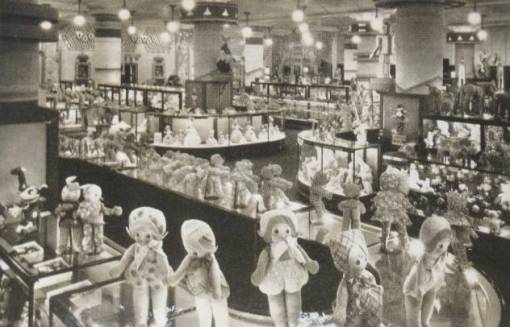
Found on google images, as all pictures in this article; This is the window of a toyshop in Chicago in the 1930s. I found it at once beautiful and slightly sinister, as all the best toys are. You have to believe they will come to life.


Grown up toys...I try not to linger too long in the make-up department

The toy department is  magical and I can still imagine the toys waiting until they are sure that the security guard has locked the front door for the night, before they come out to play at the designer makeup counters on the first floor.
I hope Carina loves her advent calendar and can imagine the world beyond the windows, one she can enter in her dreams, which causes her to long for  next morning, when she can open the next window,  which she has already probably traced and learnt the shape of with her fingers, guessing desperately at what could be behind it. 

A child's imagination makes the magic of Christmas real once again

On Boxing Day my calendar would be taken down from the wall and my mother would iron it under a towel, closing all the windows for another year. My red brick calendar lasted three years before disintegrating, and every year I would discover the windows anew. 

A wonderfully vintage looking advert for Jenners...it is in fact from 2008, but I love imagining that it is from the 1950s.

Now I'm off to Jenners to find the most beautiful advent calendar I can. Today is so clear that the sky above Jenners will be inky blue and starry by early evening, also we’ve had one or two meteorites lately. Maybe I am finally going through those little windows.

Saturday, 27 November 2010

The Flaws of Perfection

I like imperfection, the beauty that lies in a fallen eyelash on a dewy cheek, an escaped wisp of hair below a rigid ballerina bun, a vest strap which falls down in the summer to reveal a strip of lighter skin which the sun has not yet seen. I like these things because they are real, human and utterly lovely in their candidness, endearing as a child who says the wrong thing and in doing so reveals some deep truth which adults have long forgotten. 


The poets knew the power of imperfection, Shakespeare famously writing to his mistress whose eyes were ‘nothing like the sun,’ a sonnet which was later taken by Lorenz Hart as the template for his song Funny Valentine in which he asks: ‘Is your figure less than Greek? Is your mouth a little weak?’

Yet many advertisers in the world of cosmetics seem to have forgotten the potency of the less than ideal; the way it stirs within us a feeling of tenderness and recognition. 

Actress and Model Natalia Vodianova looking human, a little flawed, slightly shiny round the forehead, yet absolutely gorgeous. Her imperfection and quixotic personal style add to her beauty.


 The beautiful but flawed face which arrests the vision and forces one to look again is becoming rarer in the pages of glossy magazines. Instead we have the airbrushed perfection of L’Oreal ads, where the most exquisite of models are stripped of their human beauty and made to look strangely robotic in the case of Linda Evangelista, or doll-like in the case of Doutzen Kroes. Even the beautiful Frieda Pinto is rendered ordinary by the perfecting mechanisms of L’Oreal, while Penelope Cruz, sensual and feisty on screen, is so hardened by the L’Oreal polish that even her tumbling dark mane doesn’t soften her. 

Supermodel Linda Evangelista airbrushed to the point where she barely looks human. Is this really what the makeup companies think we want to look like? Does any woman truly want to look like this?


Rimmel adverts can also be terrible, managing, by some remarkable feat of aesthetic bludgeoning, to make both Lily Cole and Kate Moss look ordinary. How on earth do they do it?

Do these companies think that women aspire to look bland, perfected, flawless beyond the limits of their mortality? Or do they think that by making these beautiful models and actresses so bland they are bringing them nearer to the average, something which women can at once aspire to and not feel threatened by?

Lily Cole by Rimell...and below Lily as herself, embracing her own pre-raphaelite beauty. Which one do you prefer?


Whatever the reason is for this dull advertising, I call on cosmetics companies to stop it. It is at once ubiquitous and patronising. It is selling a lie which women not only disbelieve but no longer wish to hear.

Yes, airbrushing is okay and is to be expected, even demanded of fashion, that realm of fantasy and dreams. What I also demand from adverts is some individuality, something whimsical and different and unique. I like the Miss Dior Cherie Advert, where Maryna Linchuk floats away holding onto a bunch of balloons. If you look closely at this and other adverts in the same series you will see that her hair is wind-blown and the dark shadows cast by her heavy brows are still visible, adding to her reality, her loveliness, her youth, her beauty.

Like the top image this is taken from the Miss Dior Cherie advert, directed by the wonderful Sofia Coppola. I love the sense of fun and frivolity this whole campaign. To me it encapsulates what fashion and makeup should really be...an extension of your identity and individual beauty, as opposed to the bland cover-all look, advocated by too many beauty companies.